

Wayfair, one of many world’s largest house items retailers, has built-in OpenAI fashions into important inner programs to enhance provider assist workflows and product catalog high quality at scale. What started as value-testing small scale releases in 2024 has developed right into a full manufacturing system that reduces handbook effort, accelerates decision-making and improves knowledge high quality throughout hundreds of thousands of merchandise.
Moderately than deal with generative AI as an experiment or level answer, Wayfair embedded OpenAI fashions into core operational workflows. The corporate centered first the place complexity and wish for scale had been highest: routing and resolving provider assist requests and enhancing tens of 1000’s of product attributes constantly throughout a catalog of roughly 30 million objects.
“What’s been most respected is the thought partnership. It’s not simply entry to the fashions. It’s working by new use instances collectively and having the ability to transfer shortly.”
—Fiona Tan, Chief Know-how Officer
Wayfair’s catalog staff manages tens of hundreds of thousands of merchandise throughout practically a thousand totally different product lessons. Constant and correct product attribute tags—reminiscent of shade, materials, measurement or particular options—are important for search, suggestions and merchandising.
“The higher our knowledge high quality, the extra belief we construct with the client. It is important as a result of it empowers consumers to make the proper shopping for choices, instantly decreasing expensive downstream points like returns from misrepresented merchandise,” mentioned Jessica D’Arcy, Affiliate Director of Catalog Merchandising at Wayfair.
Earlier than OpenAI, tagging enhancements primarily relied on suppliers and prospects to inform Wayfair that one thing regarded improper. Guide effort couldn’t sustain with the amount. Early customized AI fashions for particular person tags had been efficient, however proved costly to construct and preserve. “We began by constructing bespoke fashions for particular person tags, and technically that labored,” mentioned Carolyn Phillips, Wayfair’s workers machine studying scientist. “However if you’re taking a look at 47,000 tags, that strategy simply doesn’t scale.”
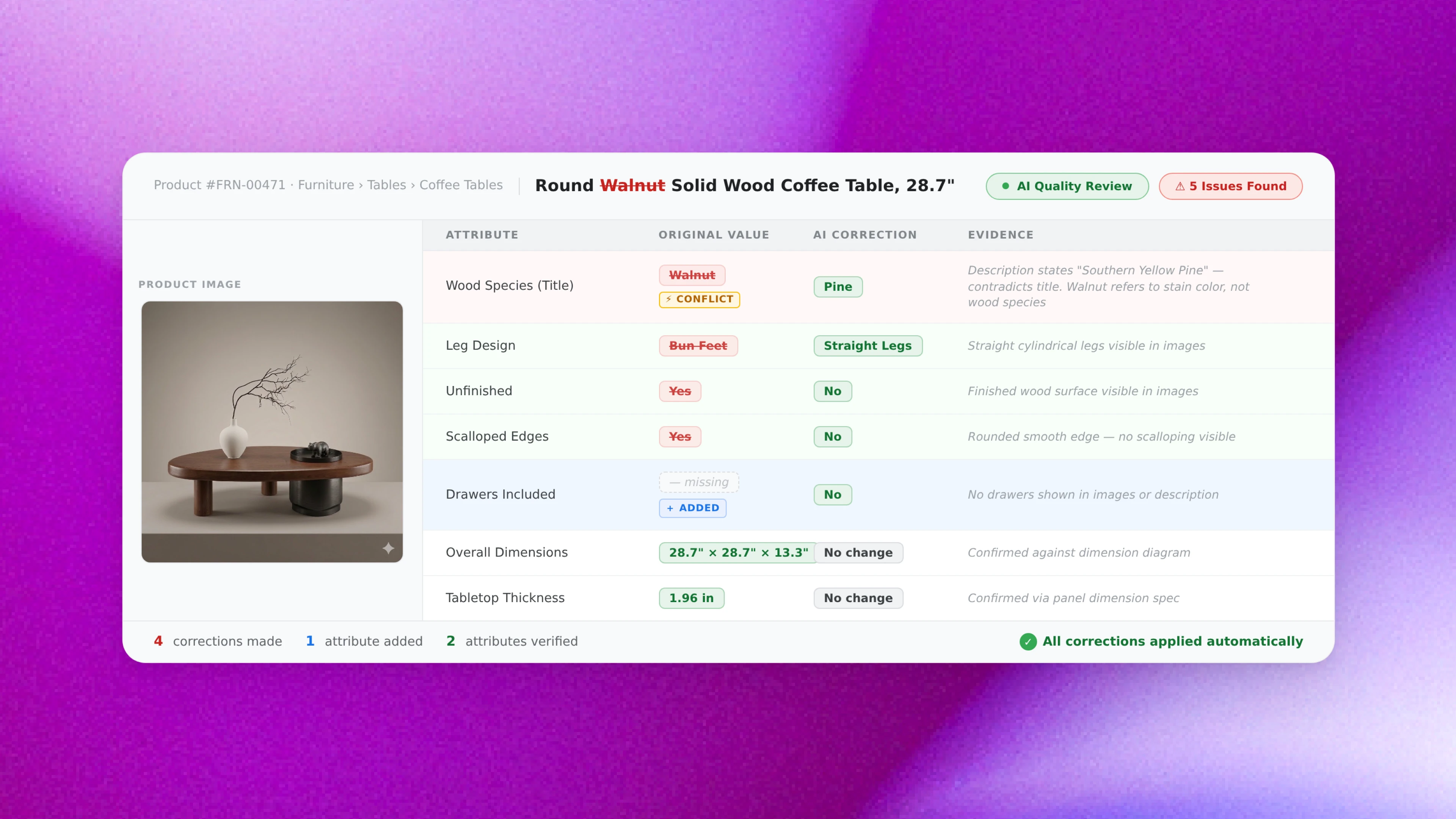
To get past one-off fashions, Wayfair created a tag-agnostic system constructed on a single OpenAI mannequin. A “definition agent” ingests the net and inner definitions to provide contextual that means for every tag. “The actual bottleneck wasn’t the mannequin efficiency,” mentioned Phillips. “It was the human time required to outline and encode what every tag truly meant.” This context, together with product knowledge aggregated from throughout Wayfair’s knowledge ecosystem, feeds right into a framework that may classify attributes throughout product lessons. The staff is now increasing mannequin protection to new attributes at 70x the speed they had been only a yr in the past.
The system has now run in manufacturing on greater than 1 million merchandise. And the primary wave of merchandise with enhanced attributes has now been stay lengthy sufficient to measure the affect of enhancing knowledge high quality on the client journey. “If you enhance attribute completeness, it’s not summary. You see it present up in search engine marketing and PLA efficiency—in how prospects uncover merchandise,” mentioned Phillips. A managed A/B take a look at confirmed a considerable and vital enhance in impressions, clicks, and web page rank within the remedy group.
Nevertheless, Wayfair did not merely hand off choices on correcting product knowledge to the mannequin. “Our goal is to construct belief in order that prospects are fully assured in what they’re buying,” mentioned Phillips. The corporate developed structured testing utilizing a hands-on audit course of wherein associates bodily examine samples to validate mannequin output, and labored with suppliers to validate modifications. Now, when data-based confidence is excessive, automated programs will overwrite the content material instantly and notify the provider of the change. And, when a excessive customary just isn’t met or the tag is deemed excessive danger, Wayfair first seeks provider affirmation earlier than making the change.
Wayfair works with tens of 1000’s of suppliers to assist their complete catalog. To handle provider assist requests, Wayfair associates traditionally reviewed each incoming ticket, manually recognized what suppliers had been making an attempt to perform, and routed points to the proper inner proprietor—a time-consuming and error-prone course of. “Provider requests aren’t easy,” mentioned Graham Ganssle, provider assist and operations at Wayfair. “They span a whole bunch of difficulty sorts, and no single affiliate can realistically grasp all of them.”
Wayfair added agentic options to a product named Wilma to enhance these workflows with AI. One of many first options in manufacturing is ticket triage powered by an OpenAI mannequin. The system reads incoming requests, fills in lacking context and routes tickets to the suitable staff. Wilma was designed to be deployable quick; constructed on a system already built-in with OpenAI APIs, it moved from prototype to stay in roughly one month. “Wilma provides associates leverage,” mentioned Ganssle. “It reads the ticket, identifies intent, fills in context from our databases, reaches again out to suppliers if needed, and factors the problem in the proper course.”
Past routing, Wayfair has deployed a dozen agentic AI flows for particular decision groups. For instance, a co-pilot for the Substitute Half Operations staff reads advanced case historical past, proposes subsequent steps and suggests draft responses that human associates evaluate. These assistants are educated on historic knowledge so that they study what success appears like in context. “The fashions can synthesize context throughout your complete journey in a means that’s exhausting for a single affiliate to do,” mentioned Ganssle. “That broader visibility contributes to greater buyer and provider satisfaction.”
Wayfair tracks how typically the AI’s suggestions match the human agent’s last determination—a metric known as “alignment price.” Inside every staff, when alignment constantly reaches a predetermined threshold, workflows can shift from assistive (“co-pilot”) to semi-autonomous (“autopilot”) modes. This staged strategy builds belief and ensures qc throughout rollout.
“In case you don’t route the problem appropriately at the beginning, all the things downstream slows down. Triage is foundational.”
–Graham Ganssle, provider assist operations, Wayfair
Wayfair stories measurable enhancements since integrating OpenAI fashions into inner programs.
On the catalog aspect, the corporate decreased the variety of improper or lacking product attribute tags a buyer would possibly see—having corrected 2.5M product tags throughout over 1,000,000 of probably the most seen and bought merchandise within the Wayfair catalog. They count on to quadruple this affect within the subsequent six months.
In provider assist, triage, co-pilot, and auto-pilot programs have elevated throughput by automating 41,000 tickets monthly (that’s as much as 70% in some workflows) and decreased turnaround occasions by eradicating routine handbook work from affiliate workloads. This dramatically cuts time to decision for a number of workflows, considerably lifts provider satisfaction, and reduces ticket re-opens in these workflows.
The broader visibility that fashions present into tickets and provider intent—past what a single affiliate can see on a display—has contributed to that enhance in satisfaction.
Operationally, groups report:
- Quicker routing and determination of advanced provider tickets
- Elevated provider satisfaction
- Decreased handbook knowledge entry and classification work
- Broader difficulty protection with out requiring experience throughout a whole bunch of matters
- Greater confidence in catalog attributes earlier than publication.
Wayfair has additionally deployed greater than 1,200 ChatGPT Enterprise seats throughout its roughly 12,000-person workforce to assist advert hoc duties, inner downside fixing and experimentation with generative fashions.
Wayfair has a protracted historical past of investing in machine studying and collaboration with AI platforms and LLM suppliers to advance their enterprise. Now, advances in frontier fashions, notably multimodal programs, are increasing what its groups can construct. That issues in house retail, the place merchandise are visible, stylistic and infrequently subjective.
“We’re excited in regards to the scope of issues we are able to now deal with,” mentioned Carolyn Phillips. “Conventional algorithms require tightly outlined datasets. These fashions permit us to work by ambiguity and context in a means that wasn’t beforehand scalable.”
Wanting ahead, the worker demand for ChatGPT Enterprise has been robust. Groups at Wayfair see it as a sensible software that helps them transfer sooner.
Buyer expectations are additionally shifting shortly. Extra consumers have gotten snug utilizing AI of their every day lives, and they’re starting to count on related capabilities after they browse, examine and purchase on-line.
“At house, prospects typically don’t have the precise phrases for what they’re on the lookout for,” mentioned Fiona Tan. “Pure language and multimodal programs assist bridge that hole.”
For Wayfair leaders, the objective stays to enhance human experience whereas scaling inner functionality. “We’re constructing for a world the place AI is a part of the purchasing journey—whether or not that’s on our web site, by assist, or by conversational interfaces,” concluded Fiona Tan.
Be part of the brand new period of labor
Greater than 1 million companies around the globe are reaching significant outcomes with OpenAI.