
Safety exploits are weighing on institutional urge for food for decentralized finance (DeFi), at the same time as broader crypto adoption continues by stablecoins and tokenized belongings.
In an April analysis observe, JPMorgan analysts stated that bridge safety stays a problem for the trade, elevating questions on whether or not DeFi can develop to help additional institutional adoption.
The latest exploit on the Versus-Ethereum bridge was the eighth main assault towards DeFi bridges in 2026 to date, with cumulative losses totalling $328.6 million.
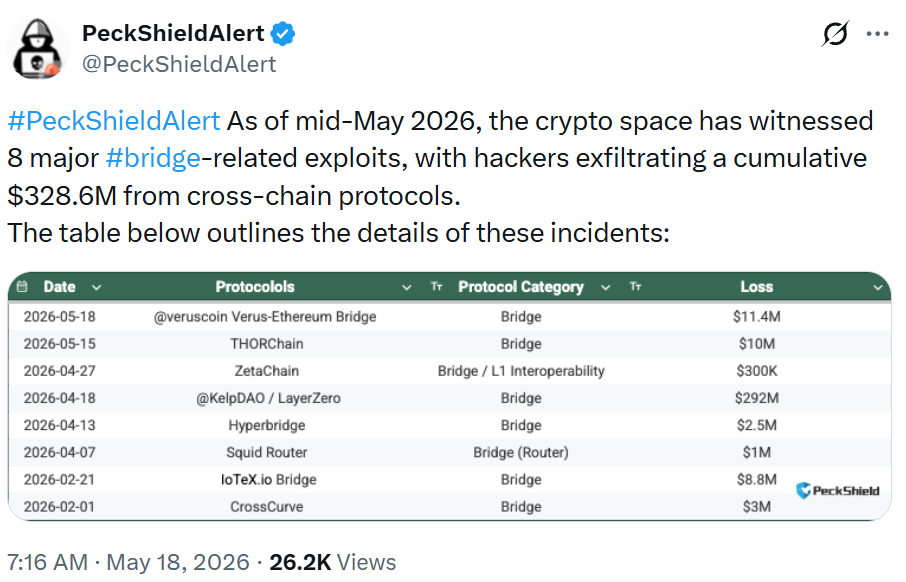
DeFi bridges stay prime targets for hackers in search of to steal hundreds of thousands of {dollars}. Supply: PeckShield
Misha Putiatin, CEO of good contract safety agency Statemind and co-founder of DeFi protocol Symbiotic, stated he repeatedly fields calls from main conventional establishments exploring DeFi publicity, typically with unhealthy timing.
“5 minutes earlier than I’ve a name with a giant conventional establishment, one other massive hack,” he advised Cointelegraph.
“They sit there taking a look at me like, ‘Is that this regular? Is that this day by day for you?”
Nonetheless, establishments could get into DeFi, however the phrases on which they arrive might reshape it into one thing that appears much more like conventional finance than the open, permissionless system its builders envisioned.
DeFi has turn out to be too complicated for DYOR
Originally of April, North Korea’s Lazarus Group was implicated within the $285 million Drift Protocol exploit, carried out by a months-long social engineering marketing campaign by which infiltrators approached Drift contributors at an in-person crypto convention.
The identical actors have been blamed for the KelpDAO breach a number of weeks later, which drained about $290 million from the protocol’s cross-chain bridge.
Whole worth locked throughout DeFi fell to round $86 billion from just below $100 billion in two days following the KelpDAO hack in April. The outflows got here from swimming pools with no direct publicity to compromised belongings, stated JPMorgan analysts.
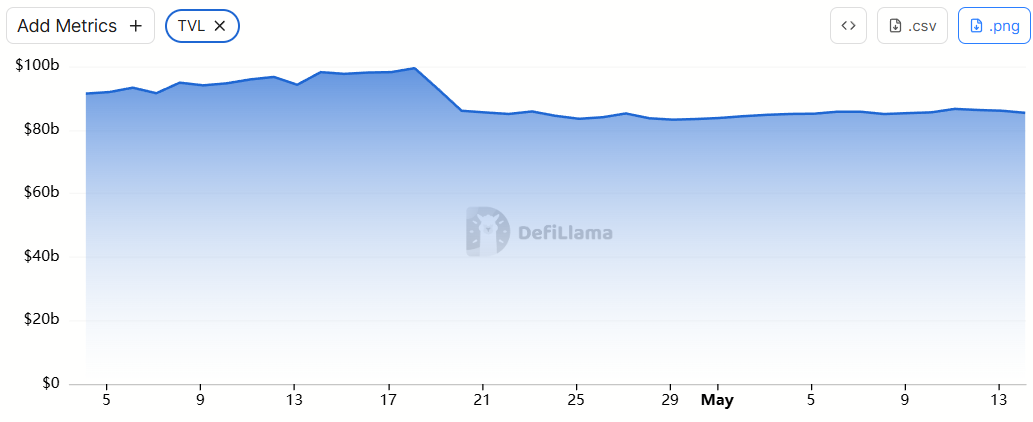
DeFi swimming pools misplaced round $14 billion following the assault on KelpDAO. Supply: DefiLlama
Associated: Wall Road’s tokenization increase has a liquidity drawback: Axis CEO
Putiatin stated the complexity of contemporary DeFi makes it practically inconceivable for abnormal customers to know the place their danger really sits. “Do your individual analysis does not work anymore,” he stated. “It hasn’t been working for a very very long time.”
He defined that the system has turn out to be too interconnected and complicated to hint.
For instance, when a person deposits Ether (ETH) to earn yield whereas by no means touching another token, they’ll nonetheless get hit by a breach on a bridge linked to a token they’ve by no means even heard of.
Do your individual analysis, or DYOR, is an trade mantra born within the early days of Bitcoin, when protocols have been easy sufficient {that a} person might learn a whitepaper and make an knowledgeable choice.
At the moment, with good contracts working as much as tens of hundreds of traces of code, protocols layered on high of each other, and new companies and tokens launching at breakneck velocity, that expectation has turn out to be virtually inconceivable to satisfy.
“I am not ever anticipating those who simply need to make investments their cash to ever work out each a part of the stack themselves,” Putiatin stated.
“I am not going to spend the subsequent two years of my life making an attempt to determine methods to get a 6% yield,” he added, claiming that conventional finance options are shut sufficient in return that the DeFi’s safety danger hardly ever is smart for many traders.
A shrinking premium for an unquantifiable danger
Tether (USDT), the world’s largest stablecoin, affords a provide APY of two.74% on Aave’s Ethereum market, the most important DeFi lending protocol. That’s under the three.57% obtainable on a three-month US Treasury invoice. Circle’s USDC (USDC) fares higher at 4.14%.
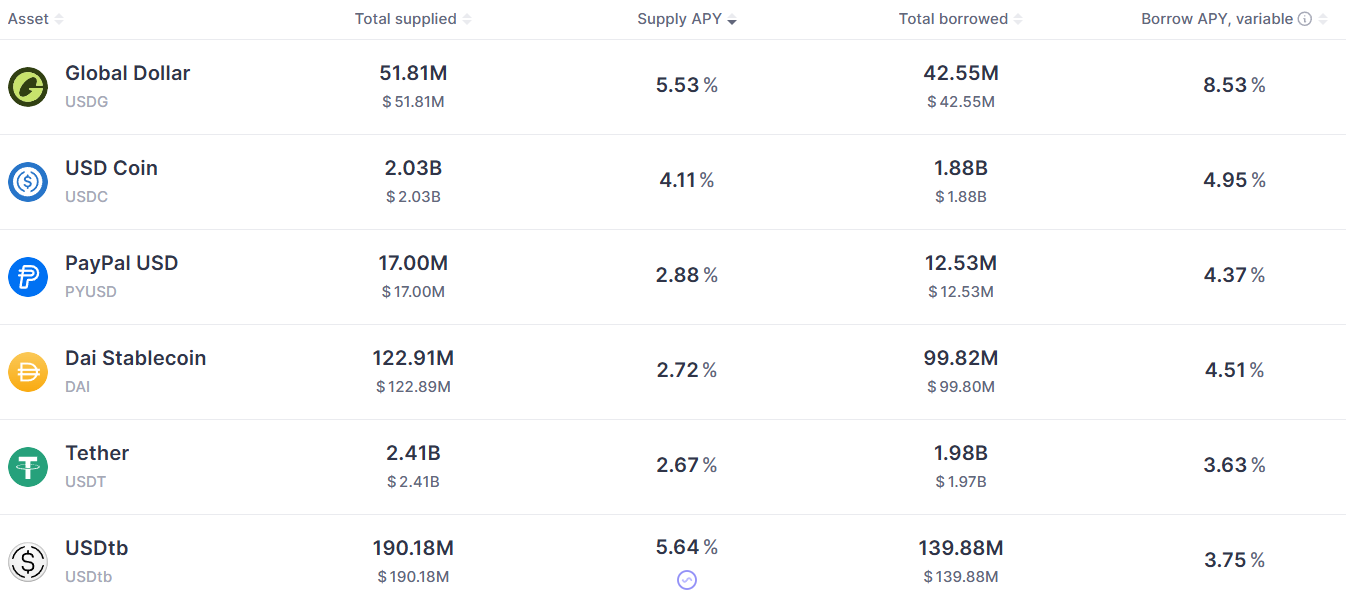
Provide and borrow APY on Aave’s Ethereum market. Supply: Aave
Associated: Why stablecoins and SWIFT could must coexist
Putiatin stated establishments see this clearly, even when they battle to quantify it exactly. The issue is that establishments haven’t any dependable framework for pricing the hack danger sitting beneath them.
“They can not value danger correctly,” he stated. “In order that they low cost the yield we offer by rather a lot.”
DeFi yields have compressed because the market has matured, eroding the premium that when justified the chance.
On the identical time, the hacks haven’t slowed down. For traders used to underwriting danger with actuarial precision, shrinking upside and unquantifiable draw back is a tough promote.
The price of DeFi’s seat on the desk
Putiatin’s benchmark for when DeFi has genuinely turned a nook is an onchain insurance coverage system able to underwriting hack danger throughout all the ecosystem and pricing it with the form of actuarial precision that establishments require.
“When we now have circuit breakers, curators that may do due diligence, and a framework for that — we’ll get the fourth one which we desperately want as an trade,” he stated. “We’ll get insurance coverage.”
DeFi has misplaced over $7.76 billion to exploits, in response to DeFiLlama information tracing again to 2016. Although DeFi insurance coverage suppliers exist, their capability stays too small to backstop something approaching institutional scale.
With out that infrastructure, establishments that do are available will accomplish that on their very own phrases, demanding full know-your-customer checks, custodial controls and tokens that may be frozen at any time.
The open, permissionless structure that made DeFi value constructing will get stripped to fulfill compliance necessities.
“All the advantages that we now have as an trade, they form of go away,” he stated. “Blockchain turns into only a database.”
It’s an consequence Putiatin finds extra troubling than the hacks themselves. The hacks, not less than, are an issue the trade can work on. A model of DeFi that establishments have hollowed out to make it protected sufficient for his or her mandates is a give up of all the pieces the know-how was supposed to alter.
Journal: 5 tech predictions the mainstream media acquired horribly flawed