
Decentralized finance (DeFi) protocols are stepping in to freeze stolen funds whereas centralized issuers face criticism for holding again.
A current intervention on Arbitrum noticed attacker-linked property frozen after a significant exploit, whereas some stablecoin issuers, together with Circle, have confronted public backlash for slower or extra restricted responses in related conditions.
Connor Howe, CEO and co-founder of cross-chain infrastructure undertaking Enso, stated that crypto protocols usually are not that completely different from centralized platforms or banks if a small group of individuals can freeze funds.
“The differentiation from a financial institution compliance officer is lower than DeFi idealists will ever admit,” Howe instructed Cointelegraph.
The controversy isn’t the same old kerfuffle between decentralization and centralization, however about who will get to intervene and the way rapidly they’ll act. In observe, it could possibly decide whether or not stolen funds are stopped or slip by way of.
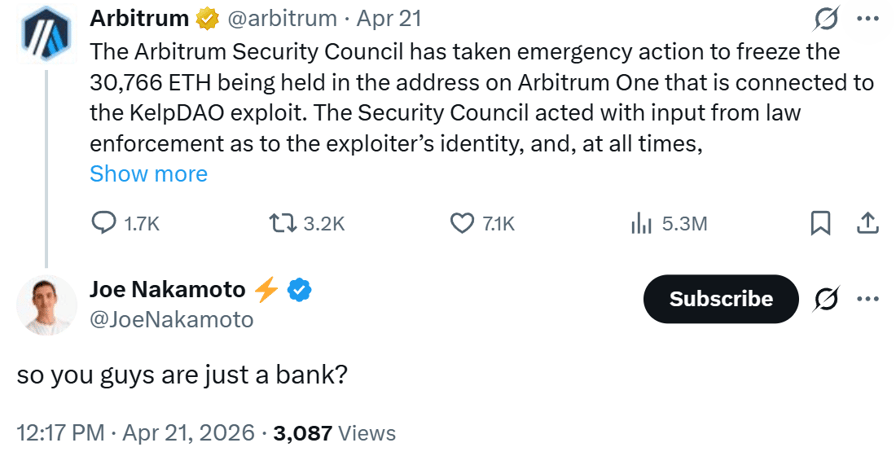
Crypto group divided on Arbitrum’s choice to freeze stolen funds. Supply: Joe Corridor
The boundaries of decentralization in DeFi
To place it merely, the business is cut up on whether or not protocols that decision themselves decentralized ought to have the ability to freeze funds throughout exploits.
Protocols like THORChain stated they can’t freeze funds by design, even throughout exploits. Safety researchers have questioned that declare, pointing to previous circumstances the place intervention did occur.
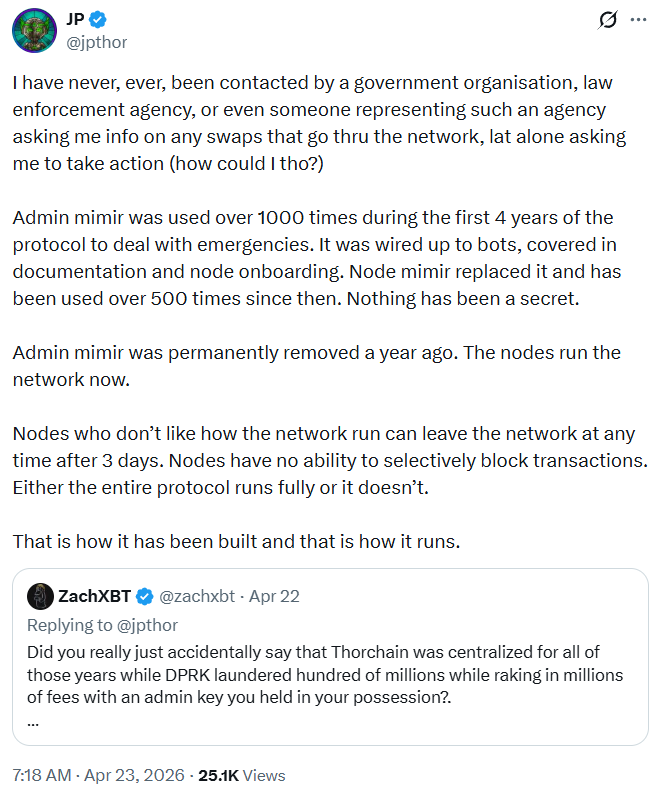
THORChain founder’s protection towards the safety group. Supply: JP Thorbjornsen
Associated: Crypto tasks shut down as token fashions fail beneath strain
Bernardo Bilotta, CEO of stablecoin infrastructure platform Stables, stated the perform is important however should function inside clear constraints.
“Freeze capabilities have to be narrowly scoped, time-limited and ruled by clear standards that existed earlier than the breach occurred,” Bilotta instructed Cointelegraph. “A protocol should not be making up the foundations whereas the home is on hearth.”
Bilotta characterised selecting “philosophical purity” over person safety as “negligence.”
The current $293 million Kelp DAO exploit introduced these discussions again into the highlight as Arbitrum froze among the stolen funds linked to suspected North Korean hackers. Some within the business stated the choice minimize towards DeFi’s grain.
The Ethereum layer-2 community has a 12-member safety council with the flexibility to hold out sure adjustments to the protocol. In emergency conditions, it could possibly achieve this by way of 9 of the 12 in its multisig pockets.
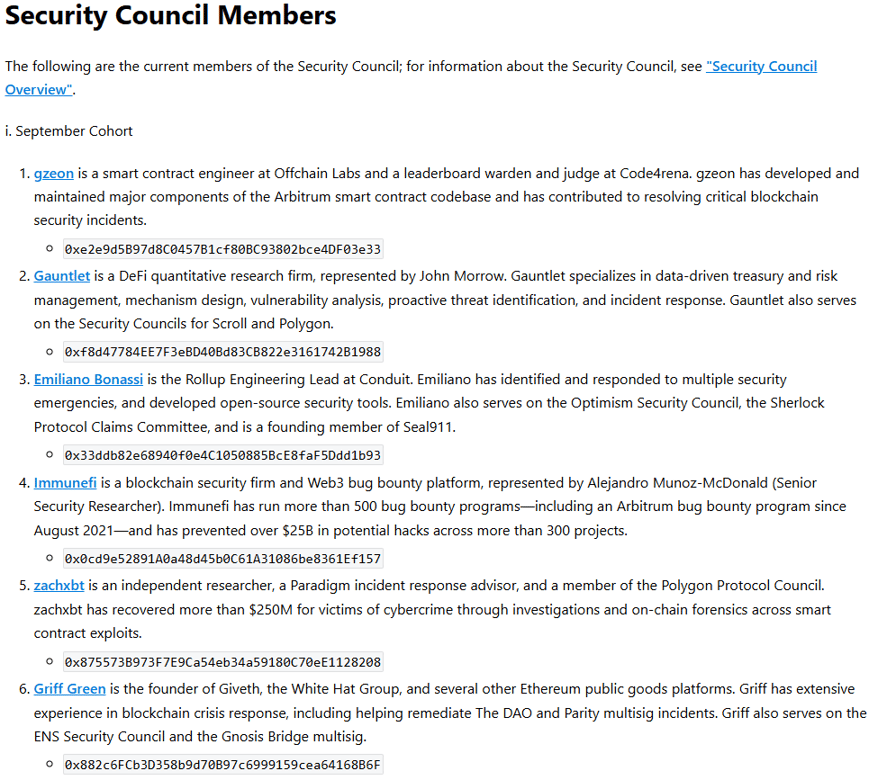
Arbitrum safety council members are voted on by the community’s decentralized autonomous group. Supply: Arbitrum
Howe stated that transparency in how such safety councils function can nonetheless separate DeFi platforms from conventional finance or their centralized counterparts.
“That is notably completely different from a TradFi establishment that invokes discretionary powers buried of their phrases of service and guarded by their authorized workforce,” Howe stated.
“There ought to be transparency in each protocol round who holds the keys, and the safeguards in place to forestall them from going rogue. If there’s no clear distinction, then it’s a obscure declare of decentralization.”
Centralized issuers face completely different constraints
Centralized stablecoins are among the many most-traded cryptocurrencies on this planet. Tether’s USDt and Circle’s USDC are the most important, accounting for greater than $266 billion in mixed market capitalization.
Each issuers have the flexibility to freeze their stablecoins, however they strategy that perform in a different way.
Whereas Tether freezes funds extra rapidly in most safety breaches, Circle emphasizes authorized course of and jurisdiction earlier than intervening,
“Let me be clear about one thing that’s steadily misunderstood: when Circle freezes USDC, it isn’t as a result of we’ve determined, unilaterally or arbitrarily, that somebody’s property ought to be taken from them,” Dante Disparte, the corporate’s head of world coverage, wrote in a current weblog put up.
“Our means to freeze funds is a compliance obligation — exercised solely once we are legally compelled by an applicable authority, by way of lawful course of,” he continued.
Circle was pushed to elucidate its stance after the current $280 million exploit on Solana-based Drift protocol, additionally attributed to North Korea.

Circle’s clarification didn’t minimize it for safety specialists demanding solutions. Supply: ZachXBT
Associated: Ethereum’s EEZ may pull different blockchains into its orbit
Bilotta stated ready for formal authorized orders in circumstances with clear, onchain proof of an exploit is a “failure of duty.”
Who decides what counts as “excessive”
Massive-scale exploits, together with these linked to North Korean actors, have pushed the business into conditions most would think about excessive, the place tons of of hundreds of thousands might be drained and laundered in actual time.
Such circumstances elevate the query of who defines what qualifies as “excessive” and when intervention is justified.
“That is the query the business has been ducking the longest,” stated Want Wu, CEO of institution-focused layer-1 Pharos.
“In observe, ‘excessive’ is simply too usually outlined after the actual fact by whoever holds the keys, which is precisely the failure mode decentralization was meant to keep away from,” he added.
Wu stated the extra credible strategy is to outline these circumstances upfront and encode them into governance, even when which means accepting that some edge circumstances fall exterior these guidelines.
“Can a small, identifiable group transfer person funds earlier than customers have a good likelihood to exit?” Wu requested.
“If the reply is sure, then regardless of the advertising and marketing says, the system is custodial in substance. If the reply is not any, solely then are we in an sincere dialog about which governance and security tradeoffs make sense for various use circumstances.”
Beneath that line, decentralization loses its substantive that means, he added.
Journal: AI-driven hacks may kill DeFi — until tasks act now